
Replace aluminium with carbon fibre when weight, stiffness or dimensional stability is limiting how a component performs. A properly engineered carbon fibre part can cut mass, control deflection and carry specific loads. Whether it pays off depends on the application, how the component is built and whether the improvement justifies the cost.
The starting point is what the aluminium part needs to do better. A tube that extends well above head height has a very different brief from a bracket bolted to a frame, even if both are aluminium today. The table below sets out the limitations that most often justify a closer look.
| Aluminium limitation | What it affects | What a carbon fibre design can change |
| Weight | Handling, moving mass, load on adjoining equipment | Meets the structural requirement at lower mass, depending on geometry and construction |
| Deflection | Reach, alignment and accuracy under load | Higher stiffness for the weight, with the laminate built to control bending |
| Directional loads | Combined bending, twisting and axial forces | Fibres placed along, across or around the tube to suit each load |
| Thermal movement | Fit, alignment and precision | Lower expansion in chosen directions, depending on laminate and resin |
| Harsh environments | Corrosion and wear in moisture or exposure | No metallic corrosion in the tube itself, if resin, finish and joints suit the setting |
Carbon fibre-reinforced polymer (CFRP)
A composite of carbon fibres set in a resin matrix. Its finished properties depend on how the fibres and resin are selected and arranged.
What problem must an aluminium replacement solve?
An aluminium replacement must solve a defined performance problem. If aluminium already meets the loading and dimensional requirements, carbon fibre may add cost without adding a practical benefit.
Aluminium is a light, versatile engineering material. It is straightforward to machine, form and assemble, which is why it appears in so many structural and industrial components. The case for replacing it strengthens when the part is struggling to meet a requirement.
Take a telescopic cleaning pole. The further it extends, the more its weight and bending affect handling, so cutting weight while controlling deflection changes how the equipment performs. Now take a stationary bracket whose weight does not affect the system around it. If aluminium already meets its loading and dimensions, a carbon fibre version may offer little.
Before changing materials, establish what needs improving. Is weight the problem? Does the component flex too far under load? Are operating conditions affecting performance? The answers decide whether carbon fibre deserves a closer look.
What are the signs a carbon fibre replacement is worth considering?
Five signs point towards carbon fibre. Weight limits performance, stiffness falls short, loads act in particular directions, dimensions must stay stable, or the operating environment is demanding. One sign can be enough to justify an assessment, and several together make the case stronger.
Is weight restricting how the equipment performs?
Reducing component weight matters most when the component moves, extends or is handled often. In lifting equipment and telescopic tubing, a lighter structure cuts the mass that operators or mechanical systems have to support. The benefit grows with the length and movement of the component.
Carbon fibre can meet structural requirements at a lower weight than an equivalent aluminium design. The actual saving depends on the geometry and construction needed to carry the load.
Does the component need more stiffness without more weight?
A component can be strong enough to carry its load and still bend too far to work properly. That is a stiffness problem.
Stiffness
How little a component bends under load. Strength is the load it carries before it fails, so a part can be strong enough and still too flexible.
Carbon fibre laminates can be engineered for high stiffness relative to their weight. On long tubes, that can control deflection without thickening the wall and adding mass. Industrial extension poles and certain aerospace components are typical examples.
Do the loads need directional reinforcement?
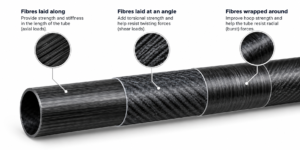
Aluminium generally behaves in the same way in every direction. Carbon fibre composites do not, because their properties depend on fibre orientation. Fibres laid along a tube, at an angle or around its circumference, let engineers build a laminate to resist different mixes of bending, twisting and axial load.
That matters for performance equipment and specialist tubular structures where forces do not act evenly. At Advanced Composite Engineering (ACE), our roll-wrapped carbon fibre tubes can be made with different fibre orientations and local reinforcement to suit the application.
Does the component need to hold its dimensions?
Some components must keep precise dimensions or alignment as temperature changes. A one-metre length of 6061 aluminium grows by about 0.024 mm for every 1°C rise. Carbon fibre composites can be engineered for much lower thermal expansion in chosen directions, depending on the laminate and resin system.
That helps with precision sleeves, spacers and other aerospace components where movement needs tight control. The finished part still has to be assessed across its expected temperature range, including how its connections and surrounding materials behave.
Does the component work in a demanding environment?
Marine and exposed industrial equipment has to cope with more than its mechanical loads. Moisture, temperature swings, repeated loading and contact with other materials all affect performance. A well-made carbon fibre composite can suit these settings where saving weight and avoiding metallic corrosion both matter.
Environmental suitability still depends on the whole construction. Resin selection, protective finishes and connection design all count, particularly where composite tubes sit alongside metal fittings.
Is an aluminium component holding your product back?
Tell us what the part needs to do and where aluminium falls short. We can advise whether a composite version is worth developing.
Explore ACE custom carbon fibre tube manufacturing
Where can replacing aluminium with carbon fibre make the biggest difference?
The biggest gains appear where weight, stiffness or reach limits the equipment, such as telescopic tubes, lifting components and performance sports gear. The value changes between industries, so ACE designs and manufactures composite components for applications across several sectors, each with its own structural and operating demands.
Commercial and industrial equipment. Lifting components, telescopic tube sets and industrial poles suit applications where cutting moving mass and controlling deflection improves operation. Composite tubing is used to replace metal components in this sector.
Aerospace. ACE supplies composite tubing for sleeves, spacers and fuel gauging equipment, where weight and dimensional requirements shape the design. Fibre alignment and geometry affect the finished part.
Marine. Carbon fibre tubes are a popular direct replacement for aluminium tubular components in yachting, including masts, bowsprits and spinnaker poles. Lower weight helps, provided the whole assembly suits the marine environment.
Military and defence. ACE has supplied tubular components for land-based systems and communications equipment, including antennae. Material choice follows the defined structural and operating requirements and the validation the application needs.
Sports and performance equipment. ACE makes paddle shafts for canoes and kayaks and tennis and badminton rackets, where mass and structural behaviour need careful control.
Material selection should start with what the component does. The strongest case for carbon fibre is a genuine limitation in the existing design that its engineered properties can solve.
When is aluminium still the better choice?
Aluminium is the better choice when simple manufacturing, easy modification, cost or specific material properties matter more than saving weight. It also suits components that take frequent local knocks, because aluminium deforms in a way that is predictable and easy to inspect.
| Requirement | Consider carbon fibre when | Keep aluminium when |
| Weight | Lower mass has measurable value | Existing weight is acceptable |
| Stiffness | A composite design can meet demanding stiffness-to-weight targets | Current deflection is within limits |
| Manufacturing | Application-specific construction is justified | Simple machining or modification is preferable |
| Operating conditions | The composite and its connections suit the environment | Metallic properties are better suited to the duty |
| Cost | Performance gains justify development | Added investment offers little benefit |
Neither material guarantees a better result without considering the complete design. Aluminium’s ductility and established fabrication methods remain valuable. Carbon fibre has limits too, including sensitivity to certain impact conditions and internal damage that may not be visible from outside.
Delamination
Separation between the layers of a composite laminate, which can happen without any visible mark on the surface.
The right choice depends on what the component must withstand across its working life. For a wider comparison with steel and other metals, see our guide to composite components versus metal.
How do connections change the design?
Inserts, bonded joints and mechanical fittings feed load into specific areas of a composite component. Those areas may need extra reinforcement or a different connection arrangement. Where carbon fibre meets aluminium fittings, galvanic corrosion is the main risk to manage.
Manufacturing decisions therefore start with the expected loading, permitted movement, dimensional requirements and operating environment.
Our approach to custom carbon fibre tube manufacturing works through these before the final tube construction is set. For engineers reviewing an aluminium replacement, that assessment decides whether the change is feasible and what the component will need to alter.
How can ACE help you assess an aluminium replacement?
ACE can assess whether a carbon fibre version of your aluminium component is feasible and what would need to change. We manufacture composite tubes and specialist components for applications where weight, stiffness, dimensions and operating requirements shape material selection.
Our experience covers industrial tubing, aerospace components, marine equipment and performance applications, and roll-wrapped manufacturing lets us build tube constructions around different loading conditions. ACE is certified to ISO 9001:2015 and holds product-specific aerospace approvals from organisations such as GKN.
These are useful starting points for an initial discussion.
- Existing drawings and dimensions: for the aluminium component and the parts it connects to.
- Loading information: the forces, movements and duty cycle the component sees.
- Operating environment: temperature range, moisture and contact with other materials.
- The improvement you want: less weight, less deflection, better dimensional stability or longer service life.
A complete carbon fibre specification is not needed to start the conversation.
Discuss your aluminium replacement with ACE
Frequently asked questions
Is carbon fibre stronger than aluminium?
It depends on the direction of the load and how the part is built. Along the fibres, a carbon fibre laminate can carry more load for its weight than aluminium, but it is weaker across them unless the laminate is designed for that load. Strength and stiffness are separate properties, so compare complete component designs, not the materials in general.
Can I replace only one aluminium tube in an existing assembly?
Yes. A single aluminium tube can be replaced without redesigning the whole assembly, provided the new component stays compatible with the adjoining parts, connections and loads. A partial replacement still needs an assessment of how forces pass through the complete structure.
Can existing aluminium end fittings be reused with a carbon fibre tube?
Sometimes. It depends on the fitting’s geometry, the loads and the attachment method. Bonded and mechanically fastened connections have to be designed for the composite construction, so assess the fitting before deciding between reuse and a redesigned connection.
Can a finished carbon fibre tube be drilled or modified?
Carbon fibre tubes can be machined, but drilling or cutting interrupts the reinforcing fibres and may affect structural performance. Assess any modification against the original laminate, loading and requirements instead of treating it like drilling aluminium.
How can hidden impact damage in carbon fibre be identified?
Impact damage is not always visible on the surface. Delamination or internal cracking can occur without an obvious fracture, so visual inspection alone may be insufficient. Use an inspection method suited to the component and its service requirements.
Does a carbon fibre component have a fixed replacement age?
There is no single replacement age. Service life depends on the material system, loading, operating environment and damage history. Replacement decisions should follow the design limits, inspection requirements and manufacturer guidance.
Can recycled carbon fibre replace aluminium in structural components?
Recycled carbon fibre can suit certain structural applications, but it depends on the recovered fibre properties, the manufacturing process and the performance required. It cannot be assumed to match a specified virgin-fibre laminate, so structural use needs proper material data and component validation.