
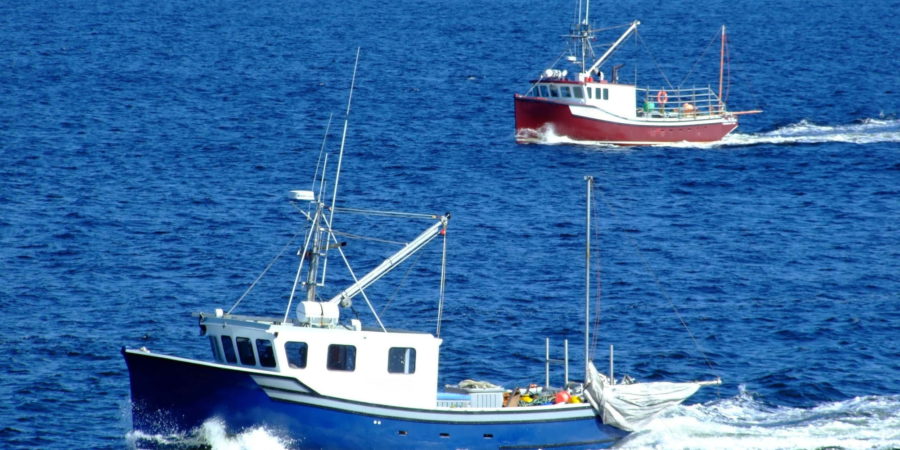
Carbon fibre is ideal for harsh marine environments because it does not corrode in saltwater, delivers an exceptional strength-to-weight ratio, and resists the cyclic fatigue caused by continuous wave loading.
Unlike steel or aluminium, carbon fibre composites accumulate far less maintenance cost over time.
However, performance in a marine environment does depend on correct resin selection, protective coatings, and deliberate design to prevent galvanic corrosion at metal interfaces.
When engineered properly, carbon fibre offers long-term structural durability, reduced vessel weight, improved fuel efficiency, and lower whole-life costs in even the most demanding marine conditions.
What Makes Marine Environments Structurally Harsh?
Marine environments expose structures to multiple overlapping stress mechanisms, not just saltwater. Key structural challenges include:
- Chloride-Induced Corrosion: Saltwater chloride ions attack protective oxide layers on metals, accelerating electrochemical corrosion and galvanic reactions.
- Cyclic Wave Loading: Continuous and compressive stress cycles from waves create long-term fatigue damage across structural members.
- UV Radiation Exposure: Prolonged sunlight degrades polymer matrices, weakening surface integrity and potentially affecting deeper mechanical performance.
- Thermal Cycling: Repeated expansion and contraction between cold seawater and warm air generate internal stress at material interfaces.
- Abrasion & Impact: Debris, mooring lines, and mechanical contact cause surface wear and localised structural damage.
- Biofouling: Marine growth increases drag, traps moisture, and can contribute to surface degradation.
- Offshore Extremes: High wave heights, tidal forces, strong currents, and low temperatures place additional structural demands on materials.
Why Doesn’t Carbon Fibre Corrode in Saltwater?
Steel corrodes because iron atoms lose electrons in an electrochemical reaction, forming iron oxide. Aluminium manages this through a thin protective oxide layer that, under sustained chloride exposure, can break down via pitting corrosion. Both processes are fundamentally electrochemical, and they require a metallic crystal lattice structure.
However, carbon fibre doesn’t have this. The carbon fibres themselves are chemically inert, with no metallic lattice structure. They simply do not participate in corrosion chemistry. Saltwater passes over carbon fibre without triggering any oxidative degradation.
Carbon fibre itself does not absorb water, but the resin that binds the fibres together can, very slowly, absorb small amounts of moisture over time.
In long-term marine use, this moisture can gradually reduce the resin’s toughness. This process is called hydrothermal ageing, and it happens very slowly under continuous water exposure.
Hence, marine-grade epoxy and resins are specifically formulated to:
- Minimise water absorption
- Maintain strength under long-term immersion
- Resist surface degradation
Protective gel coats and high-quality surface finishes add another layer of defence, preventing moisture from penetrating deeply into the composite.
In properly engineered marine components, long-term water exposure is accounted for during design, and not left to chance.
How Does Carbon Fibre Handle Wave-Induced Fatigue?
Marine structures rarely fail from a single overload. However, they fail from fatigue, the cumulative damage caused by millions of repeated wave cycles over time.
In metals such as steel or aluminium, microscopic cracks form under cyclic stress and steadily grow until failure occurs.
Carbon fibre composites respond differently. Loads are distributed across a network of fibres rather than concentrated along a single crack path. Instead of rapid crack propagation, any damage typically develops gradually within the material, allowing for longer service life under repeated loading.
Testing consistently shows that properly engineered carbon fibre laminates withstand significantly more load cycles than comparable metals at similar stress levels. This fatigue resistance is a key reason the material is widely used in racing yacht masts, offshore wind turbine blades, and high-performance marine spars.
How Strength-to-Weight Ratio Transforms Marine Design
Weight reduction in marine structures directly affects stability, speed, fuel consumption, payload capacity, and structural loading. The table below compares specific modulus and specific strength across key marine structural materials:
| Material | Density (g/cm³) | Tensile Strength (MPa) | Specific Strength | Corrosion Resistance |
| Carbon Fibre Composite | 1.5 – 1.6 | 600–1,500+ | Very High | Excellent |
| Aluminium | 2.7 | 270–310 | Moderate | Good (with treatment) |
| Steel | 7.8 | 400–550 | Low | Poor (requires protection) |
| Glass Fibre (GRP) | 1.8 – 2.0 | 200–300 | Moderate-Low | Good |
Does Carbon Fibre Absorb Water?
Carbon fibres themselves do not absorb water and remain stable even under long-term immersion. The resin that holds the fibres together, however, can absorb a small amount of moisture over time, typically around 1 – 3% in standard epoxy systems.
This does not cause sudden failure. Instead, it can slightly reduce certain strength properties, particularly under compression.
In marine applications, this is treated as a design consideration. Marine-grade epoxy systems are specifically formulated to limit moisture absorption, and protective gel coats or barrier coatings significantly reduce water reaching the structural layers.
When engineered correctly, carbon fibre components retain their performance for decades in marine environments.
Where Is Carbon Fibre Currently Used in Marine Applications?
Carbon fibre has moved well beyond racing yachts into commercial and industrial marine use. Key application areas include:
- Masts and spars: Racing and performance sailing relies on carbon fibre for the stiffness-to-weight advantage that aluminium cannot match at high aspect ratios.
- Hull reinforcements and structural beams: Replacing steel stiffeners in commercial vessels reduces topside weight and improves stability margins.
- Rudders and hydrofoils: Carbon fibre’s combination of stiffness and low mass makes it the default material for performance control surfaces.
- Offshore wind turbine components: Blade spars, nacelle structures, and transition pieces increasingly use carbon fibre to reduce structural mass at height.
- Lifeboat superstructures and patrol vessels: Weight reduction improves launch performance and fuel efficiency across service life.
- Subsea equipment frames and ROV structures: Carbon fibre resists corrosion at depth and reduces drag on underwater vehicles.
Where Carbon Fibre Is NOT the Best Choice
Authoritative engineering content requires an honest discussion of limitations. Carbon fibre does not perform optimally in every marine application, and specifying it incorrectly creates costly problems.
Deep-sea pressure hulls
Carbon fibre excels in tension and bending, but is less suited to structures subjected to extreme external pressure. Under high hydrostatic compression, thin-walled carbon shells can buckle. For crewed deep-sea submersibles, materials like titanium or specialised acrylic remain the safer choice.
High-impact or abrasion zones
Carbon fibre is strong but relatively brittle under sharp impact. Areas such as keels, rubbing strakes, or debris-prone sections are better served by hybrid designs incorporating glass fibre or Kevlar for improved impact resistance. Using pure carbon in these zones can be a design mistake.
Direct contact with metals in saltwater
Carbon fibre is electrically conductive and sits high in the galvanic series. When it touches aluminium or steel in a marine environment, it can accelerate corrosion of the metal. This risk is well understood and easily managed through insulation layers and proper detailing, but it must be designed in, not assumed away.
Key Takeaways
- Corrosion resistance: Carbon fibre does not participate in electrochemical corrosion, eliminating rust-related degradation common in steel and aluminium.
- Strength-to-weight advantage: High specific strength reduces structural mass, improves vessel efficiency, and lowers overall loading demands.
- Fatigue endurance: Carbon fibre laminates tolerate millions of cyclic wave loads with slower damage progression than traditional metals.
- Moisture management: Marine-grade resin systems and protective coatings are engineered to limit water absorption and preserve long-term mechanical integrity.
- Design dependency: Fibre orientation, laminate architecture, and galvanic isolation directly determine real-world performance.
- Application suitability: Carbon fibre delivers the greatest value where weight reduction, corrosion immunity, and long service life justify the material investment.
Build Smarter with Advanced Composite Engineering
At Advanced Composite Engineering, we design and manufacture high-performance carbon fibre tubes and structural components engineered specifically for demanding environments, including marine and offshore applications. Our team combines composite expertise with advanced roll-wrapping techniques to create bespoke solutions tailored to your structural, environmental, and performance requirements.
For all your requirements from lightweight spars, reinforced structural members, or hybrid layups that balance stiffness with impact resistance, we engineer each component to meet the exact demands of its operating environment, including Kevlar or glass reinforcement where abrasion or impact resistance is critical, and deliberate layup design to minimise galvanic interaction at metal interfaces.
Every component is manufactured in the UK under ISO 9001:2015-certified quality standards, ensuring consistent performance, structural integrity, and long-term durability. Because in harsh marine environments, material choice is not just about strength, it’s about engineering resilience into every layer.
Ready to discuss your marine or offshore composite application?
Browse our composite glossary to deepen your understanding of marine-grade materials.
Complete our enquiry form to receive a tailored quote aligned with your performance and budget requirements.
Speak directly with our carbon fibre specialists to discuss your specific structural application.
Frequently Asked Questions
1. Does carbon fibre rust in saltwater?
No, carbon fibres are chemically inert and do not participate in electrochemical corrosion reactions. The composite resin can absorb small amounts of moisture over time, which is managed through correct resin selection and surface protection.
2. Is carbon fibre suitable for deep-sea applications?
For components loaded in tension, bending, or fatigue, yes. For applications dominated by external compressive pressure, such as crewed submersible hulls, carbon fibre has limitations and other materials are typically preferred.
3. How does carbon fibre compare to aluminium for marine structures?
Carbon fibre typically offers 20 – 30% lower weight than aluminium at equivalent structural stiffness, with superior fatigue resistance and no corrosion susceptibility.
4. Does carbon fibre require maintenance in marine environments?
Significantly less than steel or aluminium. There is no corrosion to manage, no repainting required, and no cathodic protection systems needed. Inspection for impact damage and surface coat integrity is recommended, but the maintenance burden is substantially lower over a full service life.